
#MusicMarketing
#SocialMedia

The music industry has changed more in the last ten years than in the previous fifty. Today, an independent artist can release a song on a Monday and have it streaming in 180 countries by Friday. No A&R meeting, no distribution deal, no label required.
Independent artists and non-major labels now account for nearly 50% of the global recorded music market. Going independent is no longer a compromise, for a growing number of artists, it's the deliberate choice.
But access to tools doesn't automatically translate into a global audience. Distribution, promotion, and audience-building each require their own strategy, and without a label's infrastructure behind you, you're building that strategy yourself. Here's how to do it.
No label means no label-owned distribution deal. That's a good thing, it means you choose where your money goes and who you partner with.
A digital distributor gets your music onto Spotify, Apple Music, Amazon, Deezer, Tidal, TikTok, and 150+ other platforms worldwide. Here are some options for indie artists:
The right choice depends on your release frequency and budget, but any of these will get your music in front of listeners in every country, without a single A&R meeting.
Distribution makes your music available globally. Promotion makes it heard. And this is where most unsigned artists stall.
Without a label's marketing budget or industry contacts, breaking through the noise means being strategic about who you reach and how. This is exactly where Groover changes the game for indie artists.
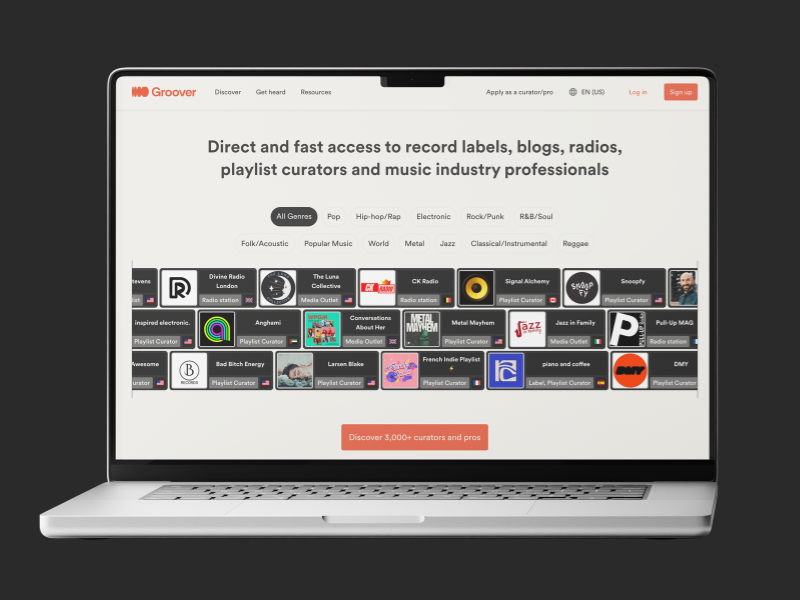
Groover is a music promotion platform built for independent musicians. You submit your music directly to the playlist curators, music blogs, radio programmers, and industry professionals of your choice, and every single contact is guaranteed to listen and respond. No more emails into the void, and no more wondering if anyone actually heard it.
What makes it especially powerful for going global: you can filter by country, language, and genres. An indie artist from anywhere can target curators in the US, press in the UK, radio in Brazil, or playlist tastemakers in Germany – all in one campaign.
Social media platforms change their algorithms. Streaming services change their payout models. The one thing no platform can take away from you is your own direct relationship with your fans.
For instance, your email list is one of your most valuable music marketing tools -- unlike your social following, it’s an audience you own and can reach directly. No algorithm decides who sees your message. Your email lands directly in your fan's inbox, whether they're in Paris, São Paulo, or Seoul.
Build this foundation early:
This year, more than 50% of independent artists named TikTok the most important platform for their growth, ahead of Spotify.
The reason TikTok matters so much for indie artists specifically is that it doesn't care about your follower count. It's For You Page will serve compelling content to hundreds of thousands of people, regardless of whether you have 50 followers or 50,000. That's a fundamentally different, and much more indie-friendly dynamic than any other platform.
A few principles that actually work:
You don't need to go viral overnight – you need to show up consistently, and build your audience progressively.
Without a label's PR team, you are your own publicist. That sounds daunting, but it's also freeing, you control the story, the timing, and the relationships you build.
Here are a few rules for pitching as an independent artist:
Press coverage and playlist placements carry credibility that your own channels can't replicate. They're how new listeners discover you for the first time, and how you reach markets you couldn't access alone.
.png?width=800&height=503&name=groover%20temple%20(1).png)
Going global without a label is real. It's happening, at scale, right now, because the infrastructure that used to require a label deal is now open to any independent artist willing to use it strategically.
Distribute your music everywhere, use tools like Groover to get it in front of the right people, build an audience you own, stay consistent on short-form videos, pitch your own press. Do those five things consistently, release after release, and the label that supposedly held the keys becomes less relevant.
You already have all the tools you need. The key is to use them properly!
Catch us next month on the Blog!
GUEST FEATURE
Written by: Apolline Lelaure, Partnerships Manager, Groover